
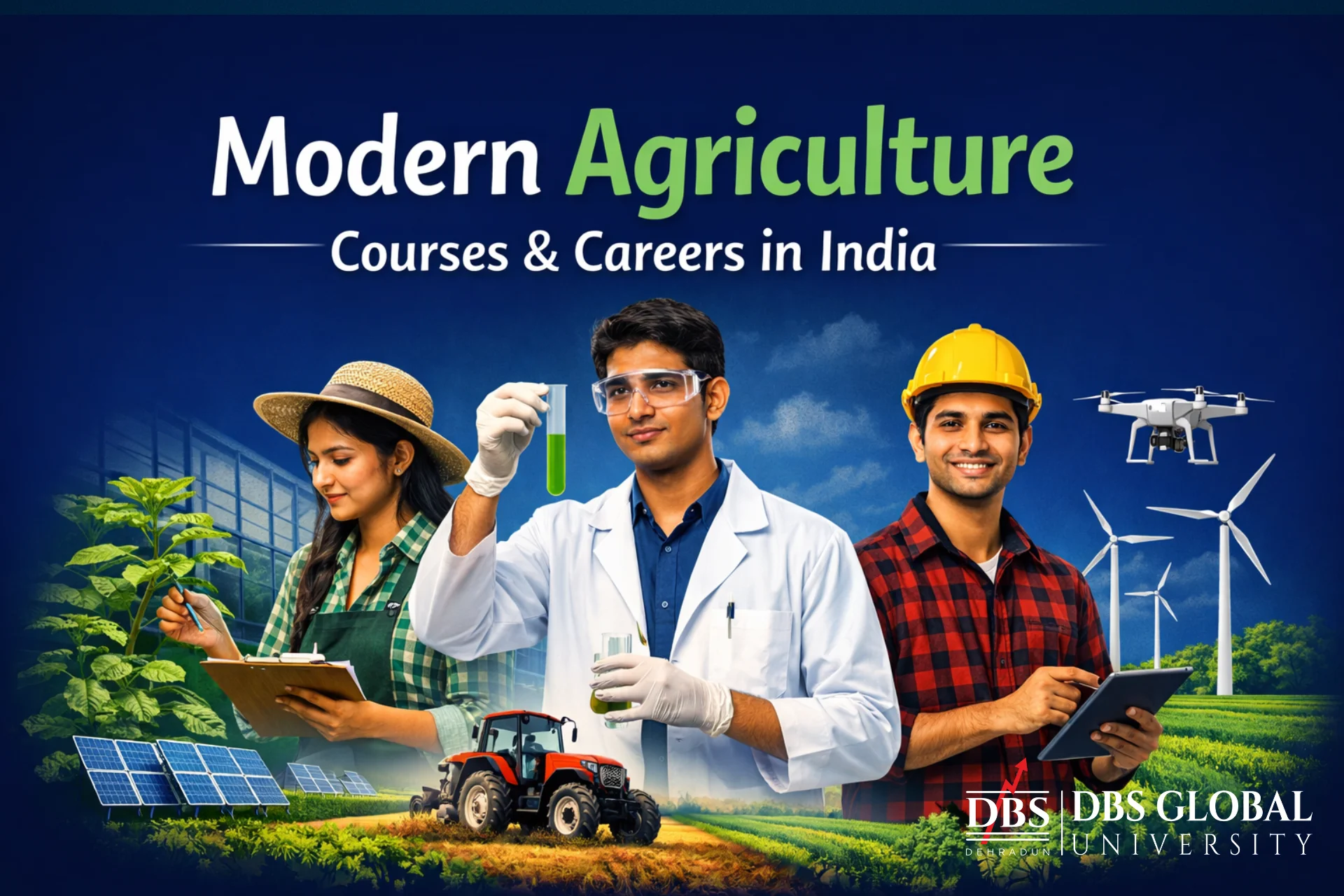
Beyond Farming: The New Age of Agriculture Education, Careers, and Opportunities in India

For generations, the image of Indian agriculture has been anchored in tradition. Today, that image is being fundamentally recast. The sector is undergoing a seismic shift, driven by technological innovation, urgent sustainability goals, and evolving economic models. This transformation is creating a new paradigm for agriculture education, careers, and opportunities that extends far beyond farming. Institutions like the School of Modern Agriculture at DBS Global University in Dehradun are at the forefront, crafting curricula that blend scientific rigour with practical, future-ready skills. This article explores this new age, where agriculture education is the gateway to roles in AgriTech, sustainable agriculture, and agribusiness management.
What to Choose a Modern Agriculture Course?
Agriculture has evolved rapidly over the years. It now blends science, technology, business, and environmental responsibility. Choosing agriculture as a course means choosing a field that is essential, future-focused, and deeply connected to society.
Here is why studying agriculture makes strong sense today.
1. Agriculture Shapes Everyday Life
Food is basic to survival. Behind every meal lies the work of agricultural professionals. By studying agriculture, students become part of a system that feeds nations and supports livelihoods.
2. A Perfect Mix of Science and Practice
Agriculture brings together biology, chemistry, soil science, environmental studies, and economics. Students learn how crops grow, how soil behaves, how water is managed, and how pests and diseases are controlled. The learning is practical, applied, and grounded in real scenarios.
3. Learning Beyond the Classroom
Agriculture cannot be understood only through textbooks. Fieldwork, farm exposure, laboratory sessions, and internships form a major part of the course. Students observe real farming challenges and learn how theory translates into action.
4. Sustainability at the Core
Modern agriculture focuses on protecting the environment while increasing productivity. Students are trained in sustainable farming practices, climate-smart agriculture, and responsible resource management. These skills are crucial for the future.
This course suits students who enjoy hands-on learning, problem-solving, working with nature, and contributing to society in tangible ways.
Which Programs Does DBS Global University Offer in Modern Agriculture?
The School of Modern Agriculture at DBS Global University offers a range of programs designed to meet different academic interests and career goals. Each program balances academic depth with practical training.
1. B.Sc Agriculture
This is a four-year undergraduate program that builds a strong foundation in agricultural sciences. Students study crop production, soil science, plant breeding, pest management, agricultural economics, and farm machinery.
The program includes extensive fieldwork, practical sessions, and experiential learning modules. By the final year, students gain hands-on exposure through internships and real-world projects.
This degree prepares students for roles in farming operations, agribusiness, research support, and agricultural services.
2. B.Sc Forestry
This program focuses on forest ecosystems, conservation, and environmental protection. Students learn about forest resources, wildlife management, biodiversity, and sustainable use of natural resources.
Graduates can work with forest departments, conservation agencies, environmental organisations, and research institutions.
3. B.Sc with Specialisation in Agri Business
This program is ideal for students who want to work at the intersection of agriculture and business. It combines agricultural science with management principles.
Students learn about agribusiness operations, marketing of agricultural products, supply chain management, and entrepreneurship. This course supports careers in agricultural enterprises and startups.
4. M.Sc Agronomy
This postgraduate program offers advanced knowledge in crop science and sustainable agriculture. Students focus on soil fertility, crop nutrition, weed management, irrigation practices, and research methodology.
The program builds analytical skills and research capabilities, preparing students for roles in research, consultancy, and higher academic pursuits.
5. MBA with Specialisation in Agri Business
This program blends core management education with agriculture-specific knowledge. Students learn leadership, finance, marketing, and operations with a strong focus on the agricultural sector.
It prepares graduates for managerial and leadership roles in agribusiness firms, agritech companies, cooperatives, and policy-driven organisations.
6. Doctoral and Advanced Research Opportunities
For those interested in academic research and teaching, opportunities for advanced research and doctoral studies are also available in agricultural sciences.
Together, these programs offer a complete academic pathway from undergraduate learning to advanced specialisation.
What Are the Career Paths Available After Pursuing Modern Agriculture?
A degree in agriculture opens doors to diverse and meaningful career options. Graduates are not limited to traditional farming roles. The sector now spans science, business, policy, research, and entrepreneurship.
Here are some popular career paths.
1. Agricultural Officer
Working with government departments or private organisations, agricultural officers support farm development programs and advise farmers on best practices.
2. Farm Manager
Farm managers oversee daily operations, crop planning, resource management, and workforce coordination to ensure efficient production.
3. Agribusiness Professional
Graduates can work in agri-based companies managing marketing, supply chains, procurement, and product development.
4. Research Associate or Scientist
With higher studies, students can enter agricultural research institutions and contribute to innovations in crop productivity and sustainability.
5. Crop Consultant
Consultants guide farmers on soil health, crop planning, pest control, and yield improvement strategies.
6. Environmental and Sustainability Roles
Agriculture graduates are increasingly needed in sustainability projects, environmental assessments, and conservation initiatives.
7. Quality Control and Food Safety Roles
Graduates can work in food processing units, ensuring quality standards, safety measures, and compliance.
8. Entrepreneur or Agripreneur
Many graduates start their own ventures, from organic farms to agritech startups, agri-consultancy services, and value-added product businesses.
The demand for agriculture professionals continues to grow across private companies, government bodies, NGOs, and international organisations.
How Is DBS Global University Different From Other Institutions?
DBS Global University approaches agriculture education with clarity, purpose, and innovation. Here is what sets it apart.
1. Modern Curriculum with Practical Focus
The curriculum balances core agricultural science with modern tools and practices. Students learn what the industry actually needs, not just theory.
2. Strong Emphasis on Field Exposure
Regular field visits, lab work, farm training, and internships ensure students gain confidence and practical understanding early on.
3. Sustainability-Driven Learning
Environmental responsibility is integrated into teaching. Students learn how to increase productivity without harming natural resources.
4. Research and Innovation Culture
Students are encouraged to participate in research projects that address real agricultural challenges, building analytical and problem-solving skills.
5. Global Exposure Opportunities
The university promotes international exposure through immersion programs, helping students gain global perspectives on agriculture.
6. Supportive Learning Environment
Located in Dehradun, the campus offers a calm, green environment ideal for agricultural studies. A diverse student community enhances peer learning.
7. Career and Placement Support
A dedicated career support system connects students with industry opportunities, internships, and professional guidance.
DBS Global University focuses on shaping confident, capable graduates who are ready to lead change in agriculture.
Conclusion
Agriculture is not just a course. It is a commitment to feeding the world, protecting the planet, and building sustainable systems for the future.
The School of Modern Agriculture at DBS Global University provides students with the knowledge, skills, and exposure needed to thrive in this evolving field. Through strong academics, hands-on learning, and a future-focused approach, the university prepares graduates to make a real difference.
For students who want a career with purpose, growth, and impact, agriculture at DBS Global University offers a path worth choosing.
Frequently Asked Questions (FAQ)
Q1. What are the career prospects after a B.Sc in Agriculture?
Ans: A B.Sc in Agriculture opens diverse roles such as Agricultural Officer, Farm Manager, Agribusiness Professional, Crop Consultant, and Research Associate. Graduates can work in the public and private sectors, NGOs, and as entrepreneurs.
Q2. How does DBS Global University incorporate practical learning?
Ans: The university emphasises fieldwork, farm exposure, laboratory sessions, and mandatory internships. This hands-on approach ensures students apply theoretical knowledge to real-world agricultural challenges.
Q3. What is the focus of the MBA in Agri Business program?
Ans: The MBA in Agri Business blends core management principles with sector-specific knowledge, focusing on leadership, finance, marketing, and supply chain management within the agricultural ecosystem to prepare students for managerial roles.
Q4. Are there opportunities for research in agriculture at DBSGU?
Ans: Yes, the university offers M.Sc Agronomy programs and doctoral research opportunities, encouraging students to engage in projects that address contemporary challenges in crop science and sustainable agriculture.
Q5. Why is sustainability important in modern agriculture education?
Ans: With climate change and resource depletion, modern agriculture education must teach sustainable practices, climate-smart techniques, and responsible resource management to ensure long-term productivity and environmental balance.
Q6. Which is the best Business School for agribusiness in Dehradun?
Ans: Doon Business School from DBS Global University (DGU) is the best school with high placement ROI in Dehradun for agribusiness management studies.